
Is Running Bad for Your Knees? What Strength Training Changes
“Running is bad for your knees.”
You’ve probably heard it before.
Maybe from a friend.
Maybe from a family member.
Maybe even from a medical professional.
And if your knees have ever felt sore after a run, it’s easy to believe it.
But here’s the truth:
Running itself is not bad for your knees. Poor preparation is.
Let’s unpack what’s really going on.
Where the “Running Ruins Your Knees” Myth Came From
A lot of people assume that because running involves repetitive impact, it must wear down cartilage and destroy your joints over time.
It sounds logical.
More miles = more pounding = more damage.
But research consistently shows that recreational runners are not more likely to develop knee osteoarthritis than non-runners. In fact, in many cases, runners have healthier knees than sedentary individuals.
Why?
Because joints adapt to stress when that stress is applied progressively.
The human body is built to move.
The problem is not movement.
The problem is overload without preparation.
What Actually Causes Knee Pain in Runners
When runners develop knee pain, it’s usually due to one of the following:
- Weak glutes
- Poor hip stability
- Limited ankle mobility
- Sudden increases in mileage
- Lack of strength training
Notice something?
None of those say “running.”
They say weakness, imbalance, or poor progression.
Your knees are often the victim, not the culprit.
If your hips aren’t strong enough to control your femur, your knee absorbs more stress.
If your calves aren’t strong, your knee compensates.
If your core doesn’t stabilize well, your stride becomes inefficient.
Running exposes weak links in the chain.
It doesn’t create them.
Your Knee Is a Hinge Joint
The knee is primarily designed to bend and straighten.
It is not built to rotate excessively or collapse inward under load.
When runners lack hip strength, especially in the glute medius, the knee caves inward with each step. Multiply that by thousands of strides, and irritation starts to build.
That’s not a running problem.
That’s a strength problem.
What Strength Training Changes
Strength training changes the game in three major ways.
1. It Improves Load Tolerance
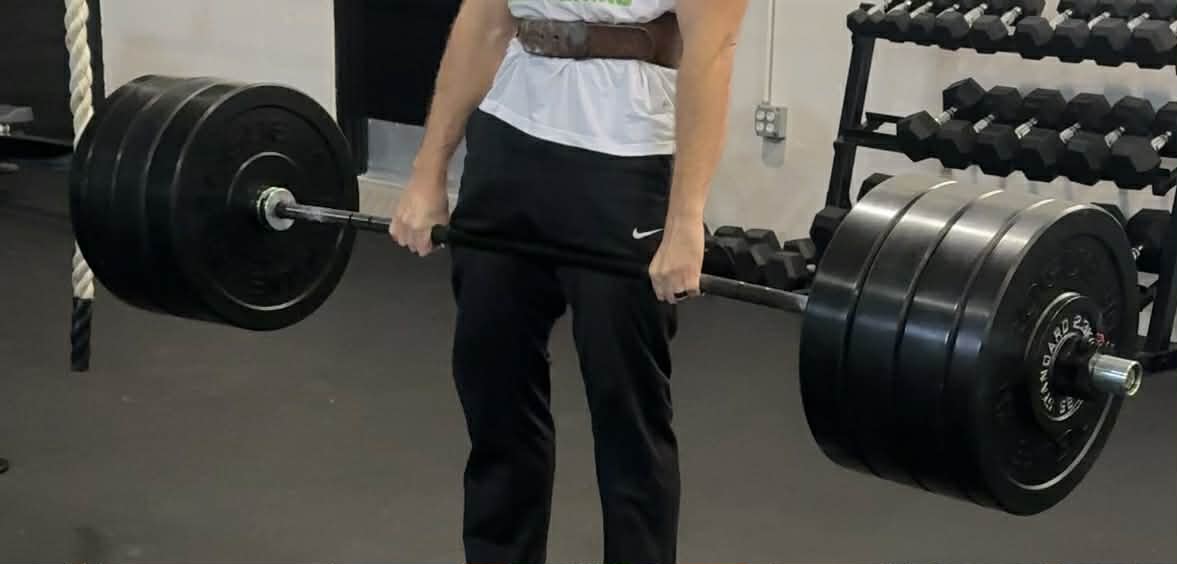
When you squat, lunge, and hinge under controlled load, you strengthen:
- Quadriceps
- Hamstrings
- Glutes
- Tendons around the knee
Stronger tissues can absorb more force.
If your legs can handle 200 pounds in a controlled squat, your bodyweight during a run becomes much less threatening.
2. It Improves Hip Stability
Single-leg exercises like:
- Split squats
- Step-ups
- Single-leg RDLs
Train the exact stability demands required in running.
Each stride is essentially a controlled single-leg landing.
When your hips are stable, your knees track properly.
That reduces irritation dramatically.
3. It Improves Mechanics
Strength training improves posture, core control, and force production.
That leads to:
- Better stride efficiency
- Reduced excessive knee loading
- More power with less wasted motion
You move better, so you stress your joints less.
But What About “Wear and Tear”?
Cartilage responds to load just like muscle does.
When load is appropriate and progressive, tissue adapts.
When load is excessive or too sudden, tissue gets irritated.
The issue is rarely the act of running.
It’s usually:
- Going from 0 to 20 miles per week
- Increasing mileage too quickly
- Ignoring pain signals
- Skipping strength work
Running 2 to 4 times per week with smart progression and strength training is not joint destruction.
It’s joint conditioning.
When Running Can Be a Problem
There are situations where caution is needed:
- Advanced osteoarthritis
- Acute knee injury
- Significant biomechanical limitations
But even then, the solution is rarely “never run again.”
It’s often:
- Reduce volume
- Improve strength
- Modify terrain
- Improve footwear
- Build gradually
Complete avoidance is usually not necessary.
Strategic modification is.
A Smarter Approach to Protecting Your Knees
If you want to run without knee pain, here’s a simple framework:
- Strength train at least 2 days per week
- Increase weekly mileage by no more than 5 to 10 percent
- Prioritize single-leg strength work
- Improve ankle mobility
- Don’t ignore persistent pain
Most runners spend hours tracking pace and mileage.
Very few track strength progress.
That’s a mistake.
Your knees don’t care about your mile split.
They care about your capacity to absorb force.
The Bottom Line
Is running bad for your knees?
No.
Running without preparation is.
When you build strong hips, strong legs, and stable mechanics, your knees become more resilient, not more fragile.
The goal isn’t to avoid movement.
It’s to become strong enough to handle it.
Strength training doesn’t just protect your knees.
It makes you a better, more durable runner for the long run.
Comments are closed